






Treatment Plan and Transparency: What Determines Its Scope?
In dental treatment, uncertainty often causes more anxiety than the treatment itself. When which procedures will be carried out, in how many stages and in what order is shared in writing after the examination, the patient can make a decision on the basis of information. This page explains how the process works before you come to the clinic.

What does a treatment plan contain?
| Section | Explanation |
|---|---|
| Clinical findings | The situation identified through examination and any necessary imaging. |
| Recommended procedures | Which procedure is recommended for which tooth, set out clearly. |
| Alternatives | Other approaches that could be considered for the same problem, and the differences between them. |
| Stages and order | Which procedure needs to be carried out first, and why. |
| Estimated course | The approximate number of appointments and the waiting periods expected for healing. |
| What happens if nothing is done? | The likely course if treatment is postponed. |
| Care requirements | What is expected in terms of check-ups and daily care after treatment. |
In comprehensive plans this information is shared in writing as well as explained verbally, so that the patient has time to think and to ask questions.
What determines the scope of the plan?
Two people presenting with the same complaint may not have the same treatment plan. The main factors determining the scope are:
- The type of problem, how widespread it is and how far it has progressed
- The remaining sound tooth structure and the state of the gum and bone support
- The bite relationship and any clenching or grinding habit
- General health, the medicines taken, smoking
- Oral care habits and the ability to attend check-ups
- The method chosen, the material used and any laboratory stage
- The need for preparatory procedures (gum treatment, bone augmentation, orthodontic preparation and the like)
A plan cannot be made without an examination. Definitive information about treatment and its scope given over the telephone, by message or from a photograph is not reliable. A preliminary discussion gives only a general idea; the plan is drawn up after clinical examination and any necessary imaging.

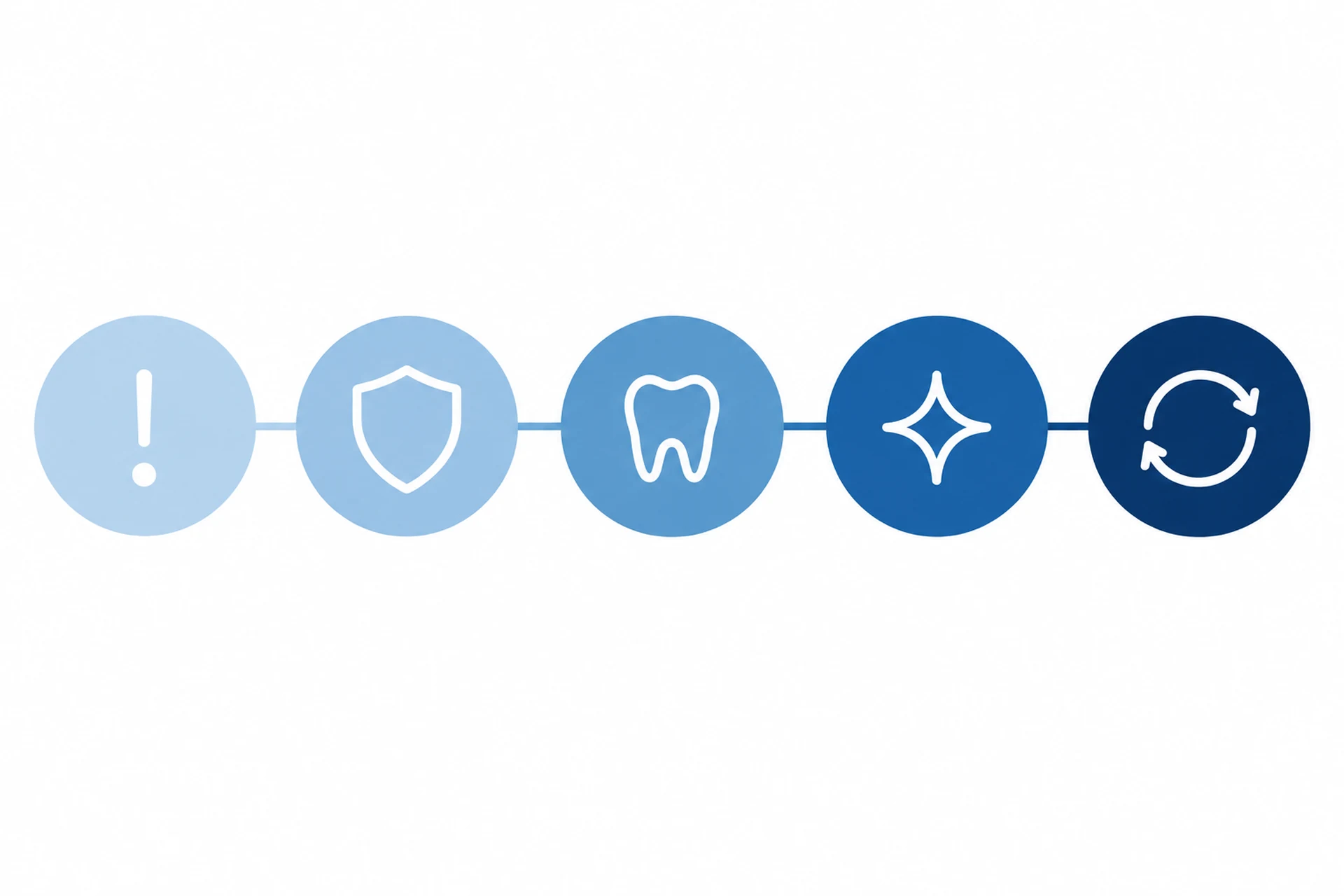
Staged planning and the order of priority
In comprehensive treatment, not everything is done at once. The order generally followed is as follows:
| Stage | Content |
|---|---|
| 1 — Emergency | Situations that cannot wait, such as pain, infection, swelling and trauma. |
| 2 — Arresting the disease | Treatment of decay, gum treatment, establishing a proper oral care routine. |
| 3 — Rebuilding | Fillings, crowns, root canal treatment, replacement of missing teeth. |
| 4 — Aesthetics | Non-essential aesthetic procedures, once health problems have been resolved. |
| 5 — Prevention and follow-up | Regular check-ups, cleaning and, if needed, a night guard. |
The purpose of this order is to ensure that the ground on which the work rests is sound. The long-term outcome of an aesthetic restoration placed while gum inflammation persists may be adversely affected.
Can the plan change?
Yes. In dentistry some findings only become visible during the procedure: the depth of decay, for example, is only fully understood while it is being removed, and the need for root canal treatment may emerge. In such cases the patient is informed and their consent obtained before the work continues. Updating the plan does not mean the initial assessment was wrong.
Social security and dental treatment
Entitlement to dental treatment under the Turkish Social Security Institution (SGK) varies according to the type of provider attended. Oral and dental health services are provided at public health facilities and at providers holding an SGK contract, within the scope defined in legislation.
Our clinic does not hold a contract with the Social Security Institution. This is stated openly here because it needs to be known before making an appointment. This section will be updated if the legislation or the contractual position changes.
Questions you can ask your dentist
- Which procedures are recommended in my case, and why?
- What are the alternatives to this treatment? What is the difference between them?
- Which needs to be done now, and which can wait?
- How many appointments is it expected to take? How long between appointments?
- What is normal to feel afterwards, and when should I call you?
- What happens if I do not have this treatment?
- What care and check-up routine will be needed afterwards?
- May I have information about the material used?
- How will I be informed if the plan changes during treatment?
Your personal data
Information obtained during examination, imaging and treatment is special category personal data. The purposes for which this data is processed, how long it is kept and the rights you hold are explained in the personal data protection notice. Detailed health information and images are not requested through the appointment form; where necessary, a secure method is notified separately.
Frequently asked questions
Can I find out the scope of treatment over the telephone?
Because the scope of treatment cannot be determined without an examination, definitive information cannot be given by telephone. After the examination, a plan specific to you is shared in writing.
Can I take time to think about the treatment plan?
Yes. Where there is no emergency, taking time to consider the plan is entirely expected. You can send us your questions later as well.
May I seek another dentist's opinion?
Yes. Seeking a second opinion is the patient's right. If you request it, your existing records can be shared.
What happens if the plan changes during treatment?
Before the work continues, the situation is explained, the options are shared and your consent is obtained.
What should I bring to my appointment?
Identification, any previous radiographs and treatment records, a list of the medicines you take, and details of any known condition or allergy. If you have a report from another clinician, please bring it with you.
Can I have an invoice and documentation?
Documentation compliant with legislation is provided for the procedures carried out. On request, a copy of your treatment records is provided.
Local assessment
At our clinic at the Beylikdüzü–Esenyurt junction, the treatment plan is drawn up by assessing the clinical examination, the necessary imaging and the patient's expectations together, and it is shared with the patient.
Dental Implant Treatment · Root Canal Treatment · Personal Data Protection Notice · Appointments and contact