






3 options for a missing tooth: leaving the gap, a bridge, or an implant
A note from your dentist
Patients who've lost a tooth almost always ask me the same thing first: "Doctor, what do we do about this spot, can we just leave it?" In this post I'm walking through, in order, the three options I go over during an exam. You can watch the same explanation in the short video above.
1. Doing nothing: what happens if you just leave the gap?
A gap can throw off the balance of your bite. The neighboring teeth can tilt toward the space, and the tooth opposite it can start growing into the gap. Studies have found this kind of over-eruption in 92% of back teeth that no longer have an opposing tooth [1]; tilting and rotation have also been found in the teeth next to the gap [2].
Once teeth start shifting, food traps more easily between them, which can speed up tartar buildup and decay. The jawbone in the area where the tooth was pulled also shrinks over time — studies show about a third to two-thirds of the bone's width is lost in the first six months after extraction [3].
For these reasons I generally don't recommend just leaving the gap. There are exceptions — the very back wisdom-tooth spot, for instance, usually doesn't get filled in. We look at that together during the exam.
2. How does a bridge work, and what should you know?
With a bridge, the teeth on either side of the gap are filed down, and a single connected piece is placed over them. Here's what you should know:
- Filing down those teeth means losing tooth structure — permanently.
- Those teeth can become sensitive, and in rare cases may even need root canal treatment.
- The bridge's middle section sits on top of the gum; the jawbone underneath it can still shrink over time.
- Cleaning underneath that middle section is tricky — it takes special tools like interdental brushes or floss threaders.
- The supporting teeth end up carrying extra load.
- Because a bridge is one connected piece, if one of the supporting teeth needs treatment later, the whole bridge may have to come off and be remade.
A bridge tends to make sense when the neighboring teeth already need large fillings or crowns anyway, or when an implant isn't a good fit for some other reason.
3. How does an implant work, and what should you know?
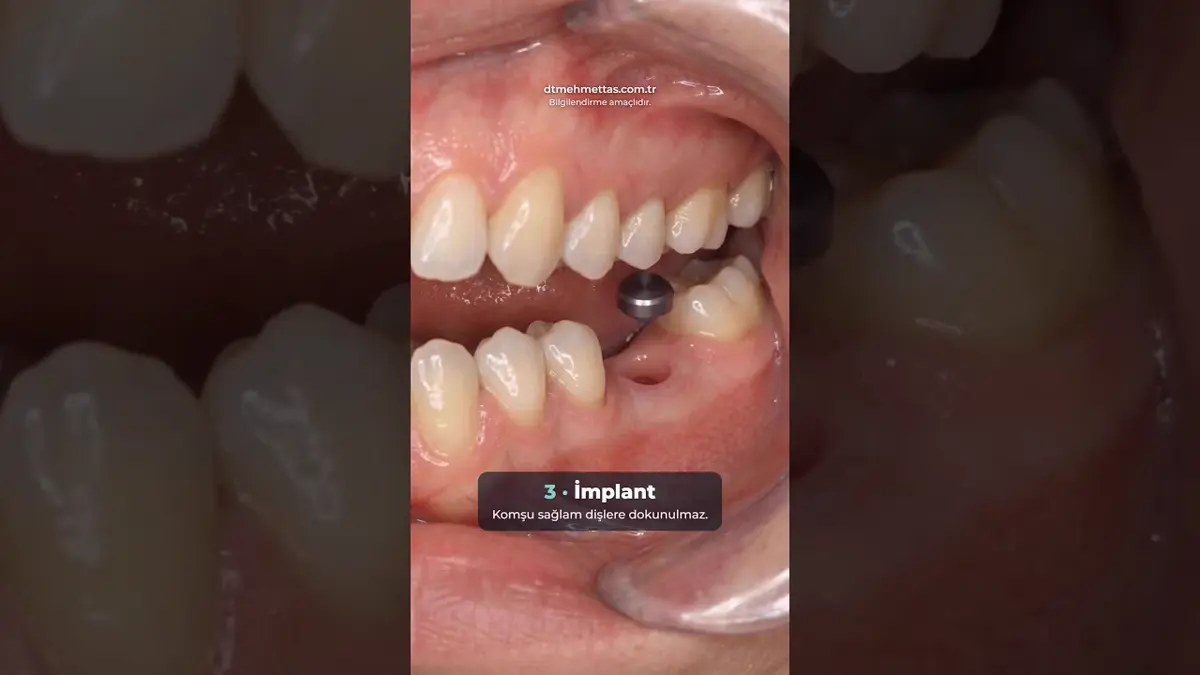
With an implant, the healthy neighboring teeth aren't touched at all — treatment is limited to the spot where the tooth is missing. The implant is placed into the jawbone and left to fuse with it. Then we take an impression — either the traditional way or with a digital scanner — and an abutment is attached to the implant, with the crown going on last.
Here's what you should know:
- An implant requires a small surgical procedure.
- It works when you have enough bone and are generally healthy; if the bone isn't enough, bone grafting may be needed first.
- Healing takes time — a few months for most patients.
- The area around an implant still needs regular care and check-ups.
What does the research say?
Here's what long-term follow-up studies show, combined:
| Still in place after 5 years | Still in place after 10 years | Most common problems | |
|---|---|---|---|
| Bridge [4] | about 94% | about 89% | Decay in a supporting tooth, loss of tooth vitality |
| Crown on an implant [5] | about 96% | about 89% | Loose screw, porcelain chipping, gum issues |
| The implant itself [5] | about 97% | about 95% | Bone loss around it |
These numbers are averages across large numbers of patients — they don't predict what will happen for any one person. For both options, the biggest factor in the outcome is oral hygiene and regular check-ups.
Which one is right for me?
We decide that at the exam. What I look at: where the gap is, the condition of the neighboring teeth, how much bone you have, your general health, and your own preference. The same gap can call for a different option in two different patients.
This article is for patient information only; it doesn't replace a diagnosis or treatment.
Sources
The research this article is based on (numbers match the bracketed references in the text):
- Craddock HL, Youngson CC, Manogue M, Blance A. Occlusal changes following posterior tooth loss in adults. Part 1. J Prosthodont. 2007;16(6):485-94. doi:10.1111/j.1532-849X.2007.00212.x
- Craddock HL, Youngson CC, Manogue M, Blance A. Occlusal changes following posterior tooth loss in adults. Part 2. J Prosthodont. 2007;16(6):495-501. doi:10.1111/j.1532-849X.2007.00223.x
- Tan WL, Wong TL, Wong MC, Lang NP. A systematic review of post-extractional alveolar hard and soft tissue dimensional changes in humans. Clin Oral Implants Res. 2012;23 Suppl 5:1-21. doi:10.1111/j.1600-0501.2011.02375.x
- Pjetursson BE, Brägger U, Lang NP, Zwahlen M. Comparison of survival and complication rates of tooth-supported fixed dental prostheses and implant-supported FDPs and single crowns. Clin Oral Implants Res. 2007;18 Suppl 3:97-113. doi:10.1111/j.1600-0501.2007.01439.x
- Jung RE, Zembic A, Pjetursson BE, Zwahlen M, Thoma DS. Systematic review of the survival rate and the incidence of biological, technical, and aesthetic complications of single crowns on implants. Clin Oral Implants Res. 2012;23 Suppl 6:2-21. doi:10.1111/j.1600-0501.2012.02547.x
This article is for general information only; a dental exam is needed for a diagnosis and treatment plan specific to you. Written by Dt. Mehmet Taş — Dentist (Istanbul University Faculty of Dentistry; MSc in Oral Surgery and Implantology, UniCamillus University).